

















Original article by Odaily (Planet Daily)@OdailyChina)
Author|Wenser@wenser 2010)
After experiencing a sudden blow during the nearly six-week-long conflict between the US and Iran, gold finally returned above $4,800 after almost a month, following news of a ceasefire agreement between the two countries.
It was mentioned as early as October 2024XAUm Gold TokenThen, when spot gold was at $3,500 last September, the forecast was for it to rise to over $3,900.Accurate predictionLater, in January of this year, when gold rose to around $4,500, it was mentioned...XAUT Gold TokenI myself started a dollar-cost averaging journey while paying attention to gold.
On the other hand, at the macro level, against the backdrop of escalating geopolitical conflicts, central banks around the world continue to increase their gold holdings, with the People's Bank of China making large-scale purchases for 17 consecutive months; major investment institutions and banks are also very confident in the upward trend of gold prices.
In light of this, this article from Odaily Planet Daily will explore a question from the perspectives of recent industry trends and changes in the political and economic situation:What is the upper limit for gold this year?
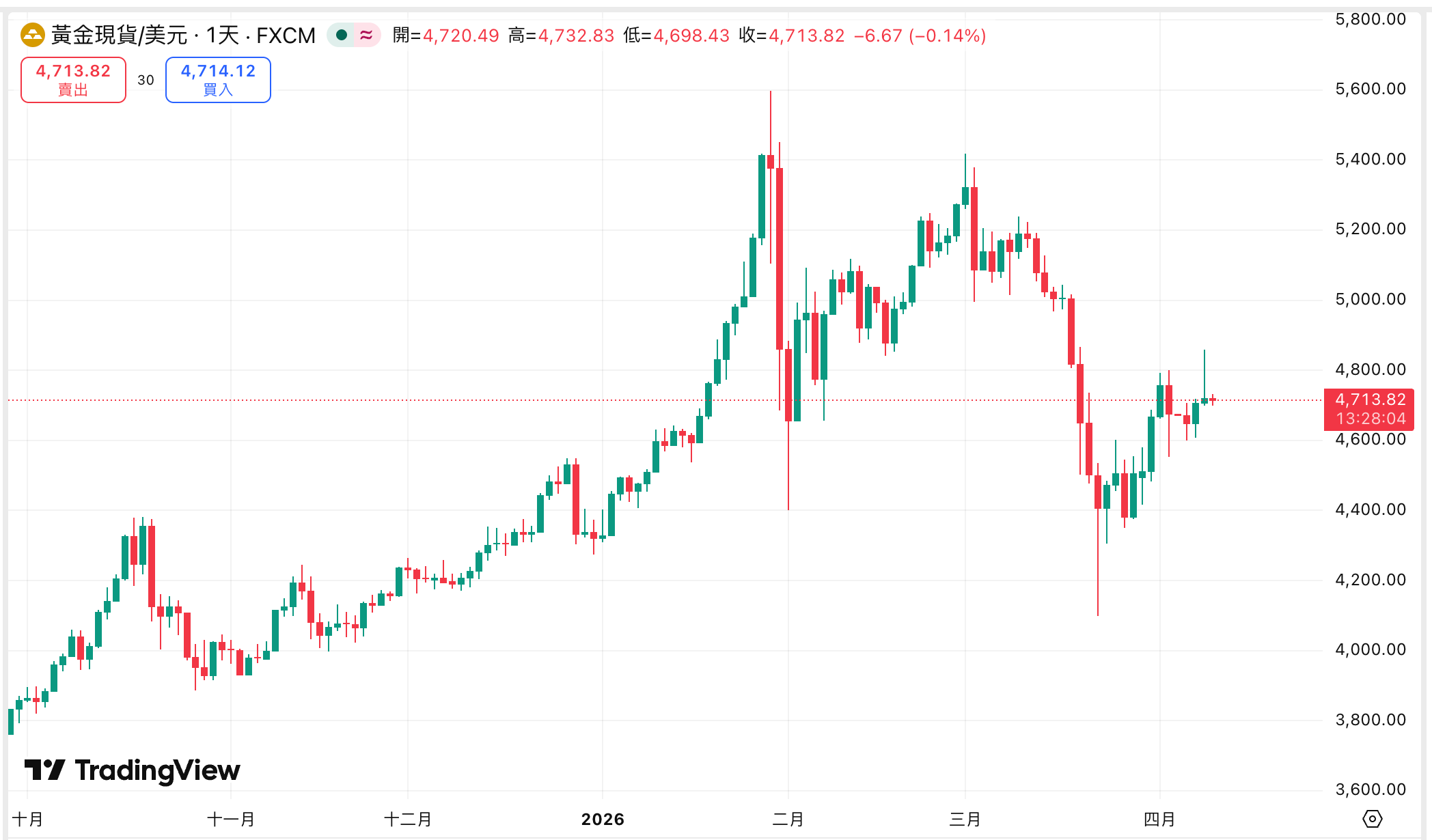
Gold price trend over the past six months
Market predictions for gold price movements: Prices may fall below $4,200 before June, but could exceed $6,000 by the end of the year.
Since its emergence, prediction markets have become an important indicator for predicting asset prices, thanks to factors such as real money betting and "collective wisdom."Currently, the price range for gold on Polymarket this year is around $3,800-$6,000.
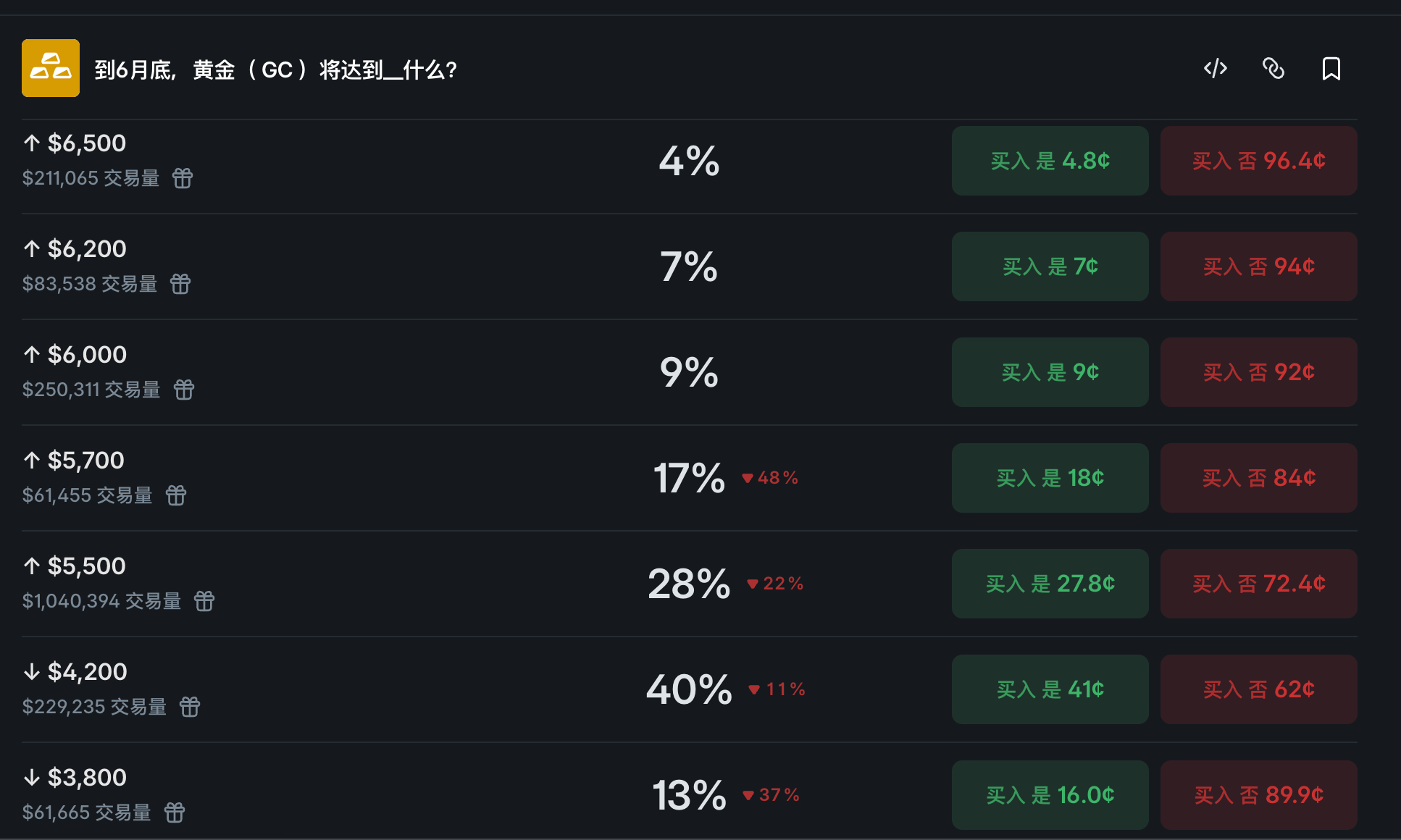
PolymarketMid-year gold price forecastThe current betting amount exceeds $3.5 million, of which:
The probability is highest for prices below $4200, at 40%.
The probability of exceeding $5,500 is the second highest, at 28%.
The next two are above $5,700 (probability tentatively reported as 17%) and below $3,800 (probability tentatively reported as 13%).
PolymarketGold price forecast for the yearThe current betting amount is only about $200,000, of which:
The probability of it being above $6,000 is the highest, at 46%.
The probability of it above $7,000 is the second highest, at 25%.
The probability of it going above $8,000 again has reached 16%.
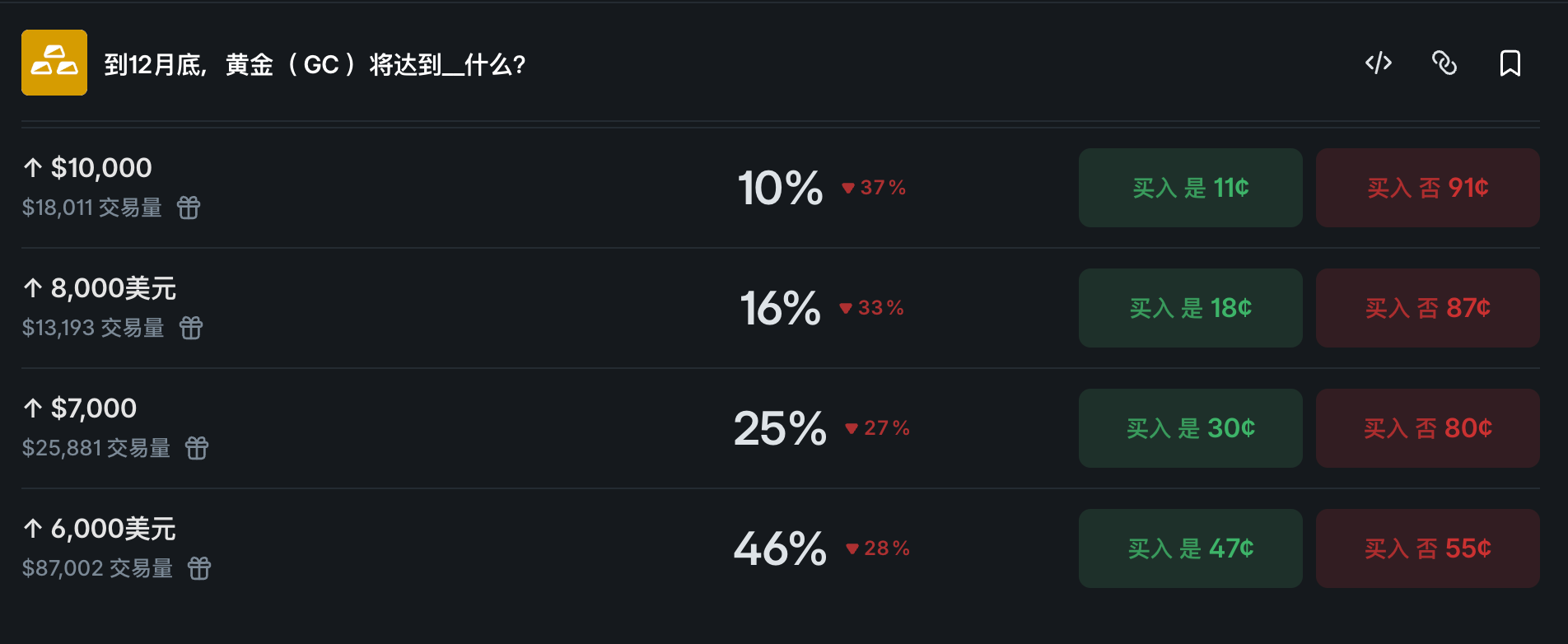
In other words, despite relatively small trading volumes, market forecasters are still pricing in prices above $6,000, which represents a nearly 20% difference, for the year.
It is worth noting that the rules for gold price-related events on Polymarket use the official settlement price of the most active month of the CME gold (GC) futures contract, excluding intraday trading, high prices, low prices, buy orders, sell orders, mid-price, or indicative prices.
Macro buying: Central banks around the world continue to increase their holdings, and the Turkish central bank exchanges gold for cash.
As the world's largest asset class by market capitalization, the largest buyers of gold are naturally central banks of various countries that control the seigniorage of fiat currencies.
In early April, the World Gold Council released...February Central Bank Gold Purchase Monthly ReportIt points out that,Central banks around the world made net purchases of 19 tons of gold in February 2026, which is still below the monthly average of 26 tons reported in 2025, but is an increase from the net purchases of 5 tons in January 2026.Furthermore, the report shows that some central banks have maintained a record of continuous net gold purchases, with a cumulative purchase of 44 tons from November 2024 to February 2026. The Czech Republic reported its 36th consecutive month of net purchases. China increased its gold holdings for the 16th consecutive month (February data).
A Goldman Sachs research report at the end of March pointed out that, supported by continued gold purchases by central banks around the world and the expectation that the Federal Reserve will cut interest rates twice more this year, the medium-term outlook for gold remains solid, with prices potentially climbing to $5,400 per ounce by the end of the year. UBS, at the end of March, projected a gold price target of $5,900 per ounce for early 2027.
On the 7th of this month,The People's Bank of China issued a document.China's gold reserves stood at 74.38 million ounces (approximately 2,313.48 tons) at the end of March, an increase of 160,000 ounces (approximately 4.98 tons) month-on-month. At the end of February, the reserves were 74.22 million ounces (approximately 2,308.5 tons), marking the 17th consecutive month of increased gold holdings.
On the other hand, established gold reserve powers have remained largely unchanged, such as the United States (approximately 8,100 tons), Germany (approximately 3,300 tons), Italy (approximately 2,400 tons), and France (approximately 2,400 tons).
Regarding the pressure on the Middle East's fiat currency system caused by the US-Iran conflict, "the Central Bank of Türkiye..."Over 120 tons of gold have been sold in the past three weeks.Regarding the claim that the company is worth $20 billion, many people only know part of the story. In reality...Most of this gold did not enter the market.Instead, it's a gold-currency swap futures contract. In simpler terms, the Turkish central bank is simply using its gold reserves as collateral to obtain US dollars, thereby stabilizing the exchange rate of its national currency, the lira.
Structurally, emerging market central banks' gold reserves still account for a low proportion of their total reserves, just over 10%, with China's figure even lower, at only single digits. This means that the room for global central banks to increase their holdings is far from saturated, and the strategic need for "de-dollarization" will provide rigid buying pressure for gold for several years.
Crypto Buying Spree: Stablecoin Giant Tether Ranks Among the Top 30 Globally in Gold Reserves
In February, Wall Street investment bank JefferiesThe report statedStablecoin issuer Tether continues to increase its gold holdings. As of January 31, its gold reserves had increased to approximately 148 tons, worth about $23 billion at current prices. Its holdings have surpassed those of many sovereign nations, placing it among the world's top 30 gold holders.
The report shows that Tether increased its gold holdings by approximately 26 tons in the fourth quarter of 2025 and continued to increase them by approximately 6 tons in January of this year. Its quarterly gold purchases are second only to a few central banks, such as Poland and Brazil. Currently, its gold reserves exceed those of countries like Australia, the UAE, Qatar, South Korea, and Greece.
The agency noted that the aforementioned gold is primarily used to support the US dollar stablecoin USDT and the gold-pegged token XAUT (currently...).FDV's market capitalization exceeds $3.3 billion.).Because Tether is a private company, its disclosed data may only represent a minimum level, and its actual gold holdings may be higher than the published figures. Tether CEO Paolo Ardoino previously stated that the company plans to allocate approximately 10%–15% of its investment portfolio to physical gold.
Retail investor buying: High-level losses determine stable holdings.
In 2026, retail investor participation in gold investment increased significantly, especially with Asian funds becoming a new main force in the gold market.
In January, Asian gold ETFs saw inflows of up to $10 billion in a single month.
Furthermore, Chinese investors purchased a record 432 tons of gold bars and coins in 2025. The scenes of long queues outside gold shops to buy accumulated gold, and the frequent sell-outs of accumulated gold on bank apps, reflect ordinary investors' strong recognition of gold's function as a store of value.
However, the opposite of retail buying was increased volatility in gold prices. In January, news of Kevin Warsh's nomination as Federal Reserve Chairman triggered a single-day plunge of over 9% in gold prices, marking the largest single-day drop in nearly 40 years. In March, gold prices plummeted to below $4,200 per ounce, leaving many retail investors trapped at high levels. This, combined with the People's Bank of China's large-scale purchases, created a stark contrast between "panic selling by retail investors and bargain hunting by sovereign wealth funds."
Therefore, the large number of retail investors who are trapped at high prices will actually prevent the gold sell-off this year from being too large.
Institutional View: Gold is poised to reach new highs, with prices potentially around $5200 by the end of June.
At the institutional level, UBS, which has always paid close attention to the precious metals market, has frequently expressed its views this year.
January 21 news, UBS precious metals strategist Joni TevesHe once saidThe demand for diversified asset allocation is the core driver of this round of gold price increases, with institutional investors, retail investors, and central banks around the world all increasing their gold holdings to cope with macroeconomic uncertainties.Gold prices are expected to maintain upward momentum in the first half of the year. If market concerns about the independence of the Federal Reserve continue to rise, gold prices may challenge the $5,000/ounce mark in the first half of the year. Silver, benefiting from rising gold prices and a narrowing supply-demand gap, may challenge $100/ounce this year.
Subsequently, gold and silver prices surged, with the former reaching nearly $5,600 per ounce and the latter reaching $120 per ounce.
February 24th news,UBS Group saidGold prices are expected to reach $6,200 per ounce in the coming months, as the key factors that have driven its strong gains over the past year remain in place.
Subsequently, on February 28, the conflict between the US and Iran officially broke out, with Israel and the United States jointly attacking Iran, thus igniting a regional hot war.
March 5th news,UBS analysts pointed out in a reportData dating back to 1900 shows that economic risks have proven to be more significant than geopolitical risks for financial markets. They argue that, in most cases, investors who can "see through" geopolitical noise perform best.
At the end of March, UBS projected a gold price target of $5,900 per ounce for early 2027.
On April 2, UBS strategist Joni TevesExpectedDespite recent gold price volatility, UBS expects gold prices to reach new highs this year and views recent pullbacks as buying opportunities. UBS forecasts an average gold price of $5,000 per ounce in 2026, $4,800 in 2027, and $4,250 in 2028.
On April 7, UBSThe gold price forecast for the end of June has been lowered to $5,200 per ounce.This is because investor demand cooled amid heightened market volatility.
In addition, in early February, JPMorgan Chase publicly...I am firmly bullish on gold.They believe that gold's year-end target is $6,300, which still represents a 34% upside.
Understanding the essence of gold: a safe-haven asset and the core of the de-dollar monetary system
Finally, let's briefly discuss the essence of gold investment.
In 1971, the United States dismantled the Bretton Woods system it had established. Subsequently, the price of gold soared from $35 per ounce to nearly $5,000 per ounce today, a cumulative increase of more than 94 times over 55 years. Considering an investment cycle of 4-5 years, it has weathered at least 10 bull and bear market cycles.
Following the outbreak of the Russia-Ukraine conflict in 2022, the economic process of "de-dollarization" accelerated dramatically, prompting global central banks to launch a new round of gold reserve competition, which gradually created the "super bull market" in gold over the past three years.
As we move into 2026, with US President Trump, instigated by Israel's Netanyahu, launching a military intervention in the Middle East...(Odaily Planet Daily note: Rumors circulate that Netanyahu personally lobbied for the US-Israel alliance to strike Iran.)Although the US political and economic situation is unlikely to deteriorate instantly due to news and policies related to AI, technology, and the return of domestic industries, the dollar's monetary credit system has already begun to show signs of decline.
In January of this year, renowned investment bank Morgan Stanley stated that...The role of the US dollar in the global system is being continuously and gradually weakened, but due to the limited number of credible alternative currencies in an increasingly multipolar world,Gold has become the biggest challenger to the US dollar.According to Morgan Stanley research, the international influence of the US dollar has declined across several indicators, including a decrease in its share of central bank foreign exchange reserves and a reduction in its use in corporate and emerging market sovereign debt issuance. Despite this, the dollar still holds the largest share of global reserves, suggesting that no substantial challenger has yet emerged. However, the situation changes when gold is taken into account. Gold's share of central bank assets has risen from approximately 14% to 25%–28%, and this upward trend shows "no signs of slowing down." Risk premiums and hedging activities will continue to put pressure on the dollar while supporting gold demand.
Despite the turmoil in Dubai caused by the US-Iran conflict casting doubt on gold's "safe-haven asset" status due to its inconvenience to carry, it remains, in the current international context, a universally recognized safe-haven asset besides the US dollar.The only hard currency.
The fact that Iran has used cryptocurrencies such as RMB and BTC to collect passage fees after closing the Strait of Hormuz, which is guarded by Iran, further exposes the reality that the credibility of the US dollar in the global economic system is declining.
Therefore, despite Bloomberg Intelligence senior market analyst Mike McGlone's warning in his April metals market outlook report...Gold and silver may have peaked.The "once-in-a-generation" peak may have passed. However, given Trump's current ambivalent and inconsistent political stance, gold is still at a relatively low point for the year.
Based on the above multi-dimensional analysis, the trend of gold in 2026 can be summarized as follows:"A peak in the first quarter, a slight correction in the second quarter, and a bottoming out and rebound in the third and fourth quarters."The three-stage structure still has an upward trend as its core logic, but the volatility will be significantly higher than in previous years.
At the current price of $4,800/ounce, gold may be in a corrective rebound phase, with $4,900 being a key resistance level in the near term. Progress in the US-Iran ceasefire negotiations, US CPI data, and policy signals from the Federal Reserve will be the most crucial price catalysts in the short term. If the ceasefire agreement continues and oil prices continue to fall, expectations of interest rate cuts will further intensify, and gold prices could challenge the $5,200 mark by the end of the second quarter.
In the second half of the year, as US inflationary pressures ease with falling oil prices, the window for Federal Reserve rate cuts will reopen, and a weaker dollar will provide greater upside potential for gold. Furthermore, the unpredictable outcome of the midterm elections will also provide some political momentum for the rise of assets such as gold and Bitcoin.
Regarding the upper limit of prices, based on a combination of institutional forecasts and market trends, the reasonable upper limit for gold prices in 2026 is predicted to be between $5,400 and $6,000 per ounce, with an optimistic scenario potentially leading to $6,200-$6,400 per ounce.
In short, the United States is like the Qin state in its waning days; "when Qin lost its mandate, other states vied for it." At this juncture, if we're talking about the most secure and reliable asset class for preserving and increasing value, what else is there but gold?
Recommended reading
More noteworthy behind the gold price pullback: the loosening of the old system.
Is Iran just bluffing by paying the Taiwan Strait customs fee with Bitcoin?