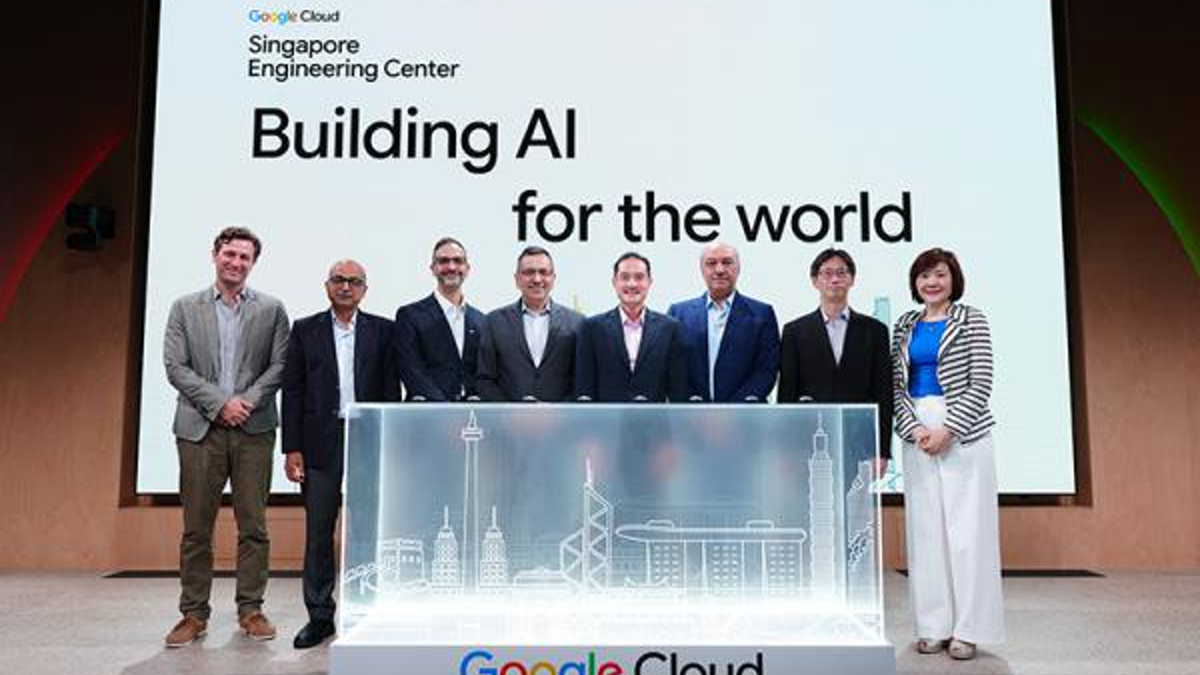


















On September 15th, Google Cloud was launched in Singapore. This is not a traditional regional sales or after-sales office. According to the company's positioning, the center will bring together professionals in AI, machine learning, data, computing, core networking, storage, and frontline support, working together with enterprises to transform basic research into deployable cloud and AI systems. It is located at the same site as Google DeepMind's first research laboratory in Southeast Asia, aiming to bring research, product engineering, and customer implementation closer together on a shorter chain of operations. Google also mentioned that the center announced its plans back in February of this year, so this launch marks the official commencement of operations; it cannot be described as a new project that was built from scratch overnight.
The bottleneck of the AI product is shifting from "whether the model is strong enough" to "whether it can be put into production."
After generative models like AI enter the corporate environment, the most common issue is not that the demonstrations are not impressive, but rather that the prototypes cannot be stably deployed in a production setting. In the experimental environment, proxies can process a few sample documents, but in the production environment, there are additional challenges such as identity and permission management, latency, costs, data retention, integration with old system interfaces, and the need to handle exceptions. A model with a high accuracy rate may still not be able to be integrated into critical processes in industries like banking, logistics, and retail if it times out during peak hours or cannot explain which customer data it is using. Google aims to bridge this gap between the research phase and production by bringing researchers, cloud infrastructure engineers, and customer-facing engineering teams together in the same center.
The directions listed by the official for the center include a scalable data engine for proxy load and resilient cloud infrastructure, integrating basic models with proxy platform capabilities into Google Cloud, as well as a API framework and proxy orchestration tools for hybrid cloud and multi-cloud environments. These descriptions still represent goals and responsibilities and do not imply that all products have been delivered yet. The center has been activated, and it is confirmed that organizational and engineering capabilities have begun to operate; however, when each technology will become generally available as a service remains to be seen, depending on subsequent product announcements and customer deployment results.
Choosing Singapore as a location also has practical engineering implications. The market in Southeast Asia varies greatly in terms of language, payment methods, network conditions, and the maturity of enterprises. An agent that performs well only with North American English data and in a single cloud environment may not be able to handle multi-language customer service, regional compliance, and cross-border business. Google hopes to identify issues together with local customers and then incorporate these solutions into global products. This approach is different from developing standard products at headquarters first, with regional teams responsible for sales; it allows local needs to be considered earlier in the design phase.
Early collaborations disclosed by the company include working with Grab on real-time multi-language AI models for stress testing, as well as developing financial agent workflows with DBS. The key terms here are “collaboration” and “development,” indicating that these capabilities have not yet been fully implemented in all business areas. Real corporate projects typically go through stages such as data preparation, offline evaluation, controlled pilots, manual review, and phased expansion. If the media only reports the phrase “financial agent,” it could easily lead to the misconception that banks have already entrusted critical decision-making to autonomous AI.
Google also expands the team of Forward Deployed Engineer. These engineers usually go directly to the customer site or project team, responsible for adapting the general platform to specific processes. In the AI era, FDE has been given renewed importance because model services are becoming more and more standardized, yet the 'last mile' of implementation is highly customized: the same customer service agent faces completely different permissions, risks, and success indicators when working with airlines versus banks. The ability to quickly convey customer feedback back to the product team has become a key factor in cloud vendors competing for large enterprise orders.
From the laboratory to the engineering center, what truly needs to be verified is the delivery closed loop.
Research laboratories are adept at developing new methods and training models, while engineering centers must meet a different set of criteria: whether the system responds on time, whether upgrades can be rolled back, whether data is isolated, whether costs are controllable, and whether customers can receive ongoing maintenance. Putting both teams in the same location can streamline communication, but it does not automatically resolve organizational frictions. Research teams strive for maximum capability, product teams focus on repeatability, and customers prefer to make as few changes to existing systems as possible. Only by establishing a common evaluation process and clear boundaries of responsibility among the three parties can the so-called “transition from laboratory to market” become more than just a slogan.
For corporate customers, the value of the new center must be judged by concrete results. First, whether the cycle from pilot to production has been shortened; second, whether the error rate for multi-language and regional services has decreased; third, whether the system can maintain service under high concurrency and failure conditions; fourth, whether customers can obtain sufficient logs, evaluation tools, and exit strategies. The number of employees hired, office space, and list of partners can indicate the investment made, but they cannot replace these operational indicators.
Security is also a part of productionization. Proxies not only generate text but may also read corporate data and invoke tools. Once models are integrated into email, financial, or customer systems, issues such as prompt injection, unauthorized calls, and erroneous executions transform from content-related problems into business risks. Engineering centers need to incorporate access control, sandboxes, approval processes, and monitoring mechanisms into the platform, rather than adding these measures temporarily just before a project is completed. The advantage of developing together with customers is that issues can be identified within the actual permission structures; however, the trade-off is that each environment becomes more complex and harder to replicate completely.
This step also reflects the change in the way cloud competition is conducted. In the past, hyperscale cloud providers mainly competed for workloads through computing, storage, and databases; today, customers are not just purchasing models API, but a complete set of delivery capabilities that range from data access, evaluation, proxy orchestration to operational monitoring. Google possesses DeepMind research, Gemini models, and Cloud infrastructure. What the engineering center in Singapore needs to prove is whether these resources can form a seamless product chain, rather than being each excellent but isolated from one another.
Singapore itself already has investments in Google Asia-Pacific headquarters, cloud regions, and data centers, providing a foundation for the talent and regional connectivity necessary for the engineering center. However, high-level AI expertise and distributed system talents are still in short supply, and corporate data will not automatically become accessible just because of geographical proximity. Whether the center can expand its influence depends on its ability to build long-term teams, develop reusable engineering modules, and convince the first batch of customers to publicly verify the results.
Therefore, this activation can be more appropriately viewed as an investment in organizational and delivery infrastructure, rather than a new product that will immediately change the market. The signal it sends is that leading AI companies are placing more resources outside of models: those who can securely integrate cutting-edge capabilities into real enterprises will have the opportunity to turn a single experiment into years of use. What is worth observing next is not the vision presented at the launch event, but the proportion of products delivered centrally, the transition of customers from pilots to production, and whether these local engineering achievements truly enter Google Cloud's global services.