



web3: DOGE falls below $0.083, weak demand suppresses rebound in ETF
CoinJournal
09-15 17:34
Ai Focus
DOGE breaks below $0.083, spot ETF activity is low, the long-short ratio is weakening, and short-term rebounds are still under pressure.
Helpful
No.Help

Dogecoin fell back below $0.083 on Tuesday. Although it found support near the short-term moving average on the previous trading day, market buying momentum did not significantly increase. The cash ETF capital flow was weak, and derivative positions were bearish. Coupled with the fact that there were no consistent signs of strengthening in on-chain and futures data, this round of recovery trend still appears fragile.

Spot ETF capital flow remains weak

SoSoValue Data shows that US spot Dogecoin ETF trading has been generally inactive since last week, with no significant inflow of funds observed. DOGE Although it has rebounded from around $0.070, institutional funds have not increased their positions accordingly.

If ETF continues to stagnate, DOGE will lack an important source of incremental demand. If it later turns into a net outflow, short-term selling pressure may further increase.

The long-short ratio has declined, indicating a bearish market sentiment.

CoinGlass Data shows that the long-short ratio on DOGE dropped to 0.84 on Tuesday, reaching a level not seen in over a month. A long-short ratio below 1 indicates that there are more short positions than long positions, suggesting that traders are generally betting on a decline in prices.

The funding rate signals something slightly different. DOGE The funding rate, which is weighted by position size, became positive on September 9th, reporting 0.0010% on Tuesday. This indicates that the demand for leveraged long positions has not disappeared, but the current level is still low and not sufficient to reverse the pressure brought about by bearish positions.

The market summary for CryptoQuant also shows that large orders have appeared in the DOGE futures market, but sellers still hold the dominant position. The activity in the spot market has increased somewhat, however, other indicators remain near neutral.

Short-term support is between $0.081 and $0.082.

Currently, DOGE is still trading above the level of $0.081 from the 50-day EMA and $0.082 from the 100-day EMA, forming a short-term support zone. However, its price is still below the $0.092 level of the 200-day EMA, indicating that the medium-term trend has not yet strengthened.

From the perspective of momentum indicators, the Relative Strength Index RSI is close to 47, indicating that the forces of bulls and bears are roughly balanced; MACD is still slightly below the zero line, suggesting that the upward momentum is limited.
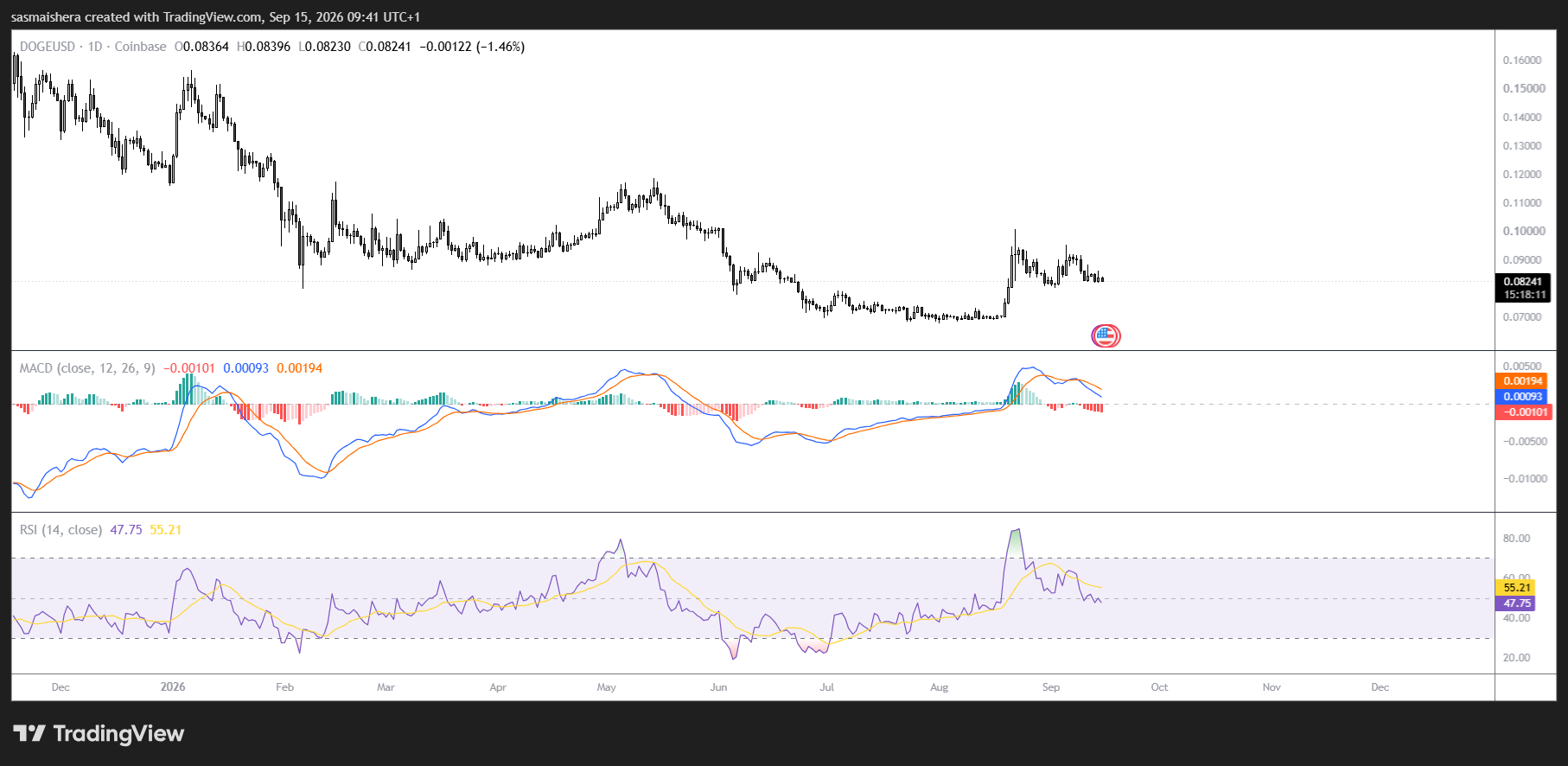
If the price reclaims 0.088 US dollars, the market may test resistance around 0.092 US dollars; if it breaks through further, the next more significant supply zone is at 0.102 US dollars. On the contrary, once the support range of 0.081 to 0.082 US dollars is lost, DOGE might revisit the 0.070 US dollar area.

Tip
$0
Like
0
Save
0
Views 628
HKWDB reminds readers to view blockchain rationally, stay aware of risks, and beware of virtual token issuance and speculation. All content on this site represents market information or related viewpoints only and does not constitute any form of investment advice. If you find sensitive content, please click“Report”,and we will handle it promptly。
Submit
Comment 0
Hot
Latest
No comments yet. Be the first!
Related
CFTC Chairman Says Binance Hacker Attack Indicates That Offshore Exchanges Need US Regulation
Michael Selliger, chairman of the U.S. Commodity Futures Trading Commission (CFTC), stated that the $6.4 billion hack incident at Binance “precisely demonstrates” the necessity of the crypto market regulations proposed by the agency this month. He described the attack as being more likely caused by a vulnerability introduced through a laptop rather than a flaw in the blockchain itself; however, Binance later indicated that the investigation had uncovered “more entry points” for the attack.
Decrypt
·2026-10-31 23:10:23
11
Intel experiences its largest single-day decline in over forty years; the NASDAQ falls nearly 3%, gold drops to a one-year low, and crude oil continues to rise for four months in a row.
Amazon and Intel's financial reports disappointed the market. Investors are increasingly skeptical about the returns on the huge AI expenditures of these tech giants. All three major U.S. stock indices closed lower, with tech stocks leading the decline, while energy and essential consumer goods sectors performed strongly against the trend. Driven by the Middle East situation, crude oil prices rose to a six-month high; U.S. Treasury yields fell, gold dropped to a one-year low, and Bitcoin lost its support below $77,000.
Wallstreetcn
·2026-10-31 22:30:06
31
I went on vacation with two iPhone, and Duo convinced me to do so.
The author tried out Apple's new iPhone Duo during a five-day vacation. Initially, due to application issues, Touch ID, and the camera, among other factors, they considered returning to their original iPhone. However, by the end of the trip, they changed their mind, finding that although this foldable phone has its shortcomings, it is indeed fascinating.
TechCrunch
·2026-10-31 22:21:57
34
After Binance was attacked by hackers, how should investors protect the security of their crypto assets?
On October 29, Binance was attacked by hackers, with an estimated loss of $6.3 billion, which has drawn external attention to the recovery of stolen funds, the exchange's compensation commitments, and the lack of a similar deposit insurance protection mechanism for crypto assets like FDIC. Experts say that whether an exchange compensates usually depends on its own willingness and financial capability, and while self-hosting by individuals can reduce some platform risks, it also brings new security hazards.
CNBC
·2026-10-31 22:11:08
37
Intel's market value evaporated by nearly 29% in a single day: High demand for AI, so why has the chip manufacturer seen a decline?
Intel's market value evaporated by nearly 29% on October 30, despite its artificial intelligence business experiencing the fastest growth in years. The company's revenue in the third quarter increased by 21% to $16.5 billion, with revenue from its data center and AI divisions growing by 78% to $7.3 billion. However, limited production capacity, an accident at a factory in Israel, and weak performance in the PC business led to fourth-quarter guidance that fell short of Wall Street's expectations.
Coinpaper
·2026-10-31 22:03:41
39
View More