











"I think I want to switch back to my other iPhone."
I have to admit that during this five-day vacation, I said this phrase multiple times. During that period, I traveled with the new iPhone and Duo. I encountered issues such as app crashes, unfamiliar gestures, discomfort when returning to use Touch ID, and concerns regarding the camera, which forced me to carry two phones with me at all times.
But by the time the trip was over, I no longer wanted to change back.
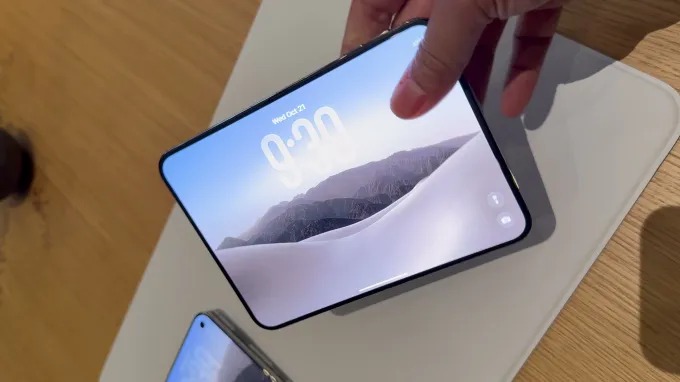
The first time I opened Duo – which was a prototype loaned to me by Apple – I truly felt a sense of excitement. As I tore off the original factory seal and turned on the device, a wave of anticipation swept through me. Looking back, that was probably the first signal that Duo would eventually touch me deeply.
As a technology journalist, over the years I've received many test devices, so unfortunately, the excitement I used to feel when opening up a new gadget is no longer what it used to be. However, in the few days before the shipment of the Duo, I actually started to really look forward to it. I began to calculate potential upgrade options and figure out how I could afford this phone, which costs $2000. I also started reading reviews on the TikTok about protective cases for the Duo. What made me hesitate wasn't just the price; switching to the Duo also meant a major change for me, especially since I was originally using the iPhone with a 17 Pro Max. There's almost nothing similar between those two phones.
Since I was preparing to go on vacation when Duo arrived, I decided to bring 17 Pro Max along as a backup. However, I ended up using Duo more often and gradually got used to it during the trip, although there were some troubles along the way.
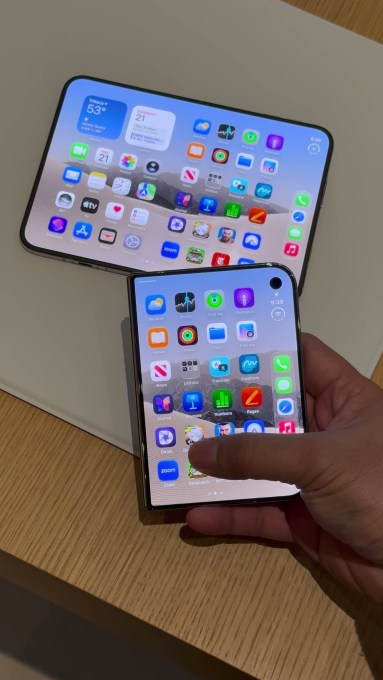
There is always a psychological cost associated with changing phones, especially when switching from a high-end phone to a more experimental device like Duo. For those accustomed to the technology and slender rectangular design that has been refined over a long period with iPhone, Duo being shorter, thicker, and quite novel indeed proved a bit uncomfortable at first.
“Where did all that extra screen space I used to have go?” I complained. “Can this really fit comfortably in my pocket?”
It turns out that it's possible. Both the front pocket and the back pocket work just fine, and it's the same even with a protective case on. You can even sit down with it in the back pocket; even if you press the phone down, it won't get damaged. Although I intended to be more careful, I kept forgetting about this – I usually put my phone in the back pocket when I'm walking. The number of times I've sat on this phone is countless. Clearly, it's not that fragile after all.
I also accidentally dropped my phone at least three more times. Twice it fell from a height roughly equal to the desktop, and once it was pushed off the edge of the bed. It didn’t land on a soft carpet; instead, it hit concrete, tiles, and wooden floors. Surprisingly, it didn’t break, and the screen didn’t crack either. Strictly speaking, this certainly doesn’t count as a professional drop test, but for someone as careless with their phone as me, it’s definitely a relief.
Although it's not Apple's fault, this issue later became my biggest annoyance at the software level, as search is one of the applications I use most frequently during my travels. During holidays, I would open it repeatedly to look up information about attractions, restaurant reviews, distances between towns, weather, and so on. However, Google's app would simply stop working, and clicking the back button had no effect.
It seems that there is an issue with the AI mode in the search app, and now you are often brought into this mode without any active request from your part. (This is even more annoying than AI searches!) The current workaround is to force-close the app, so that the next time you open it, you will be taken back to the homepage with a search bar. I'm quite surprised that, at a time when Google is facing a decline in search traffic due to AI, they don't prioritize ensuring that their own search app functions properly on Apple's latest devices!
In addition, many early reviews pointed out that when Duo was launched, many applications had not been updated or redesigned for it. This meant that there would be a prominent black border on the sides of these applications, which further squeezed the already limited screen space when the phone was in folded mode. This issue indeed exists, but personally, it was not enough to be a decisive reason for me to decide against switching to Duo.
On one hand, the speed at which various companies are releasing updates to adapt to Duo is actually quite fast. Those that haven't been updated yet – and there are still quite a few of them! – can still be used, but they just don't look… very good.
During the trip, Google Maps was not optimized for Duo, but I had no problems using it for navigation, searching for local information, discovering nearby amenities, and planning routes. If there was any impact, the black borders on the app were more of an aesthetic issue than a functional one. However, when Duo was in folded state, those black borders indeed appeared smaller than usual.
I expect that all mainstream applications will eventually be updated. As for those old applications that never get updated? I think it's time to let go of those applications that are no longer maintained, especially in an era where AI-driven hacking tools are taking advantage of vulnerabilities in old software everywhere.
However, I agree with the complaints of other reviewers regarding the absence of Face ID.
This is the biggest drawback of Duo. It's not the screen, not the camera, nor the lack of a Action button to activate your preferred AI assistant; it's Touch ID.
It's much easier to look at my phone than to fiddle with the finger buttons. I hardly ever encounter any problems when unlocking my device – I almost always wear the Apple Watch, which can serve as another form of authentication – but when using applications and the Apple Pay, I often get stuck.
Using card payment when making a transaction is one of the scenarios where you can immediately feel how Face ID makes daily operations so much smoother. However, when you return to Touch ID, paying becomes rather clumsy; you often have to hold a shopping bag in one hand, a bag in the other, and in my case, I also have to hold a dog leash, while at the same time trying to use my phone for payment.
To switch back from Face ID to Touch ID, one has to overcome what I might call “muscle memory.” I found that the most comfortable way to hold the phone is to support it in my hand and then use my thumb to complete the verification. However, the part where I kept making mistakes was forgetting to keep my thumb or finger on the Touch ID sensor for long enough to complete the authentication. Sometimes my finger didn’t position itself correctly—I blamed the dog pulling on the leash for that!—and I had to readjust. “I miss Face ID!” I complained several times in front of the checkout counter.
Although I eventually got used to returning to Touch ID, it's far from ideal. I can imagine that this could become a real obstacle for some early adopters who decide not to switch to Duo. It's not an insurmountable problem, but in my opinion, it's also one of the main reasons not to buy Duo right now. (It is said that future versions will support Face ID.)
Is there another reason to be wary of Duo? Cameras. There have been many discussions about the weaker camera systems of Duo. Duo only has two rear cameras, while my iPhone and Pro Max have three. It doesn't have a telephoto lens, and its 10x digital zoom is not even as good as the 40x zoom of the Pro model. The Pro model has more advanced hardware for low-light photography and also supports ProRAW, ProRes, and other advanced features.
In simple terms: if you are a iPhone photography enthusiast or content creator, you should not use the Duo as your primary device.
But for us ordinary users, the camera of Duo is still fine. It's not outstanding, but it's sufficient. What were you originally planning to do with these photos? Post them on Instagram Stories or Facebook? Send them to friends? Look at them again when they reappear in the main screen's photo widget? Or use them as a lockscreen wallpaper? None of these uses require a camera of Pro quality.
Below are some photos taken with Duo and also with 17 Pro Max. None of the photos use any special settings or filters; I deliberately chose to take casual, amateurish shots. One of my complaints is that the image processing of Duo sometimes makes details such as leaves appear overprocessed. At the same time, the distant scenery may seem flatter, as if smoothed out – but to be fair, the Blue Ridge Mountains are often shrouded in mist, so it’s hard to say how much of that is due to the camera. (The lighting was quite dim when taking photos at the mountaintop; it was almost dark.)
DUO Photos:
PRO MAX Photos:
So, why buy this phone? The answer is simple: it’s a foldable phone, and it comes from Apple. First of all, foldable phones have a playful charm that straight-screen phones will never have. They’re essentially toys for adults! Developers seem to enjoy developing apps for this new form factor as well, so there are many new apps to explore. Plus, it’s perfect for watching movies, especially when paired with a Duo Folio protective case that comes with a stand.
Secondly, it is Apple's foldable phone. Apple has taken the time to get it right, and this is reflected in the details, such as almost invisible creases and a consistent aspect ratio between the two screens, which allows content to scale proportionally. It is also part of Apple's software ecosystem for foldable phones, which is very important for those who switch between Apple devices and services and use and pay for applications designed specifically for iOS.
But I have a small confession: in my daily life, I don’t use Duo as often as I originally imagined. (To clarify: of course I do use it! I just thought I would use it more frequently!)
There are two reasons for this. First, unfolding a device in public can lead to conversations, which feels a bit like showing off; I don't always have the time for small talk. I expect that as the novelty wears off, this issue will gradually diminish.
Nevertheless, during my vacation, I talked about this phone with about six strangers, ranging from other customers to waitstaff, and even the shop owner. Sometimes I even handed the phone to them (with the condition that they wouldn’t run away with it immediately!), allowing them to fold and unfold it themselves. There was one person who was particularly interested in the Kid Cue feature, which displayed funny Snoopy animations on the phone’s outer screen, attracting children to look into the camera while taking photos. They really liked this feature.
From these sporadic exchanges, it's clear that most people are amazed by the unfolded screen: "You can't see any hinges!" "Is that a screen protector, or is it supposed to look like that?" (The inner screen features a matte nano-textured surface that reduces reflection. After being explained, people also describe it as "quite cool.")
"What if sand gets in?" asked someone who had previously used a Samsung Galaxy Fold. Their old Android foldable phone got sand stuck in the hinge after a trip to the beach, which damaged the screen. (At that time, this was not uncommon.) The protection level of Duo is IP68, where "6" indicates a higher dust resistance, meaning it is completely dust-proof. In contrast, the protection level of Galaxy Z Fold 8 is IP48. I don't think it will have the same problem, but I do hope that a reviewer will take it to the beach to test it soon!
I am certain that at least one of those strangers and me had never really seen a foldable phone before. Now that Apple has created such a product, it means that this concept is no longer just a niche gimmick; it will become well-known among the mainstream population.
Another reason why I don’t expand it as frequently as I expected is that once I do, it feels like I’m officially starting a more intentional period of screen time. Now, I only expand my phone when I really need to get something done seriously, such as reading Netflix or using split-screen multitasking by dragging two apps side by side. I really enjoy using Inoreader to read news while simultaneously opening X to see how others are discussing that news, but that’s not a scenario that everyone uses!
The split-screen feature is also very easy to use – after opening the app, slide your finger up from the bottom, then drag it to the left or right edge. The target frames on both sides will help you determine where it can be placed, which is very helpful. (You can also long-press the app icon to open split-screen mode, but I don’t use that method as often.)
But as a "mini" phone with a smaller screen when folded, I tend not to use those applications that I consider a waste of time, such as TikTok, Instagram, or casual games.
I’ve been thinking about this a lot. I don’t believe that the reason is simply that the screen space is smaller in folded state, or that vertical-screen applications are not designed to accommodate the expansion of Duo to landscape mode. From the perspectives of practicality and usability, these concerns certainly make sense, but I think there’s something else behind this change in behavior.
Over the years, smartphones have become larger, taller, thinner, and more comfortable to hold. As a result, they have effortlessly drawn us into the digital world. The design of Duo seems to break away from the smartphone's tendency to effortlessly lure people in, leading to constant app openings and endless swiping.
On the contrary, Duo is more like a device that you only turn on and use when there is a reason to do so, rather than something you would instinctively pick up just because you're bored or have a few minutes to spare. Since the best usage scenarios for these apps occur after the phone is unfolded, and unfolding itself is an action that requires careful consideration (as well as careful handling!), the use of the device becomes more deliberate and thoughtful.
This is not a bad thing. It also echoes the current trend of retro technology that is on the rise – knobs, dials, and buttons make people's interaction with technology more conscious.
For this very reason, despite its shortcomings, Duo has still convinced me. It’s a phone that is both attractive and interesting to use – I enjoy picking it up, but I also find it easier to put it down again.