



web3: Tokenized stock weekly trading volume approaches $3 billion
Coinpaper
09-06 22:08
Ai Focus
Tokenized stock trading is heating up, with weekly spot trading volume approaching $3 billion. Robinhood Chain, BNB Chain, and Solana have become the main platforms for this activity.
Helpful
No.Help

Tokenized stock trading is entering a larger scale phase. Data from Grayscale shows that in early August, the weekly spot trading volume in this market approached $3 billion, with Robinhood Chain, BNB Chain, and Solana accounting for the majority of the transactions.

This means that investors are increasingly obtaining exposure to the prices of traditional stocks through public blockchains. Unlike the previous landscape dominated by a single network, current tokenized stock trading has clearly shifted towards multi-chain parallelism.

Three public chains dominate the main transactions.

Grayscale pointed out in the latest research that Robinhood Chain, BNB Chain, and Solana are the three chains with the highest trading volumes for tokenized stocks currently. The trading infrastructure is mainly provided by decentralized protocols such as Uniswap, PancakeSwap, and Raydium.

Robinhood Chain is one of the new entrants that has seen relatively rapid growth. This network launched its public beta mainnet on July 1st, is compatible with Ethereum, and is built on Arbitrum technology, targeting financial services and the tokenization of real-world assets.

Robinhood indicates that eligible users can trade Stock Tokens through Robinhood Wallet. This covers over 120 countries and regions, with the specific scope of availability depending on the local jurisdiction. The system supports 24/7 trading and also allows users to integrate related assets into decentralized trading as well as potential lending and collateralization scenarios.

The scale of use on the chain has risen to over $110 million.

In addition to the growth in trading volume, the use of tokenized stocks in blockchain finance is also expanding. Grayscale data shows that the total locked-up value of protocols using tokenized stocks has risen to over $110 million, whereas for most of 2025, this figure was below $10 million.

One of the main protocols that drove early growth was the Kamino of the Solana ecosystem, and subsequently, Jupiter also became a new source of lending activities. At the same time, the trading platforms on Solana, BNB Chain, and Robinhood Chain also contributed to the overall expansion.

However, according to Grayscale, currently only about 5% of the market value of tokenized stocks is deployed in blockchain financial applications. This means that at this stage, the market is still dominated by buying and selling transactions, with lending, mortgages, and other uses still accounting for a limited proportion.

With a market value of about $3 billion, it is still smaller than that of tokenized funds.

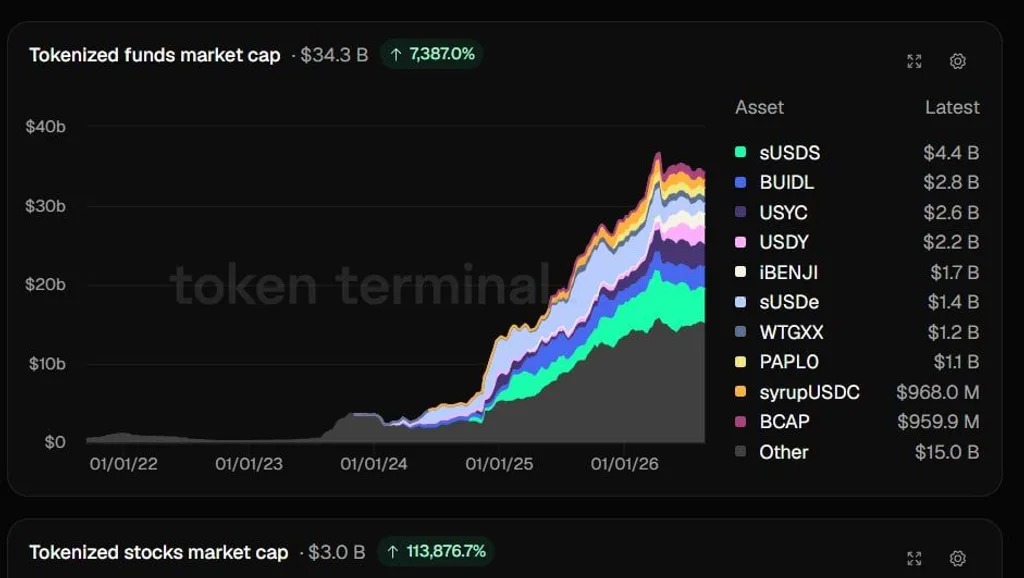
Token Terminal data shows that the current total market value of tokenized stocks is approximately $3 billion. In contrast, the scale of tokenized funds has reached $34.3 billion, with representative products including sUSDS, BlackRock's BUIDL, and USYC.

It is important to distinguish that the approximately $3 billion mentioned in Grayscale refers to the weekly trading volume, which reflects the scale of turnover within a week; whereas the $3 billion provided in Token Terminal represents the total value of tokenized stocks in the market. Although these two figures are close, they have different meanings.
At this stage, the growth of tokenized stocks is still mainly driven by trading demand. If more assets are subsequently used for collateral and lending, the role of this market in DeFi may further deepen.

Tip
$0
Like
2
Save
2
Views 675
HKWDB reminds readers to view blockchain rationally, stay aware of risks, and beware of virtual token issuance and speculation. All content on this site represents market information or related viewpoints only and does not constitute any form of investment advice. If you find sensitive content, please click“Report”,and we will handle it promptly。
Submit
Comment 0
Hot
Latest
No comments yet. Be the first!
Related
CFTC Chairman Says Binance Hacker Attack Indicates That Offshore Exchanges Need US Regulation
Michael Selliger, chairman of the U.S. Commodity Futures Trading Commission (CFTC), stated that the $6.4 billion hack incident at Binance “precisely demonstrates” the necessity of the crypto market regulations proposed by the agency this month. He described the attack as being more likely caused by a vulnerability introduced through a laptop rather than a flaw in the blockchain itself; however, Binance later indicated that the investigation had uncovered “more entry points” for the attack.
Decrypt
·2026-10-31 23:10:23
11
Intel experiences its largest single-day decline in over forty years; the NASDAQ falls nearly 3%, gold drops to a one-year low, and crude oil continues to rise for four months in a row.
Amazon and Intel's financial reports disappointed the market. Investors are increasingly skeptical about the returns on the huge AI expenditures of these tech giants. All three major U.S. stock indices closed lower, with tech stocks leading the decline, while energy and essential consumer goods sectors performed strongly against the trend. Driven by the Middle East situation, crude oil prices rose to a six-month high; U.S. Treasury yields fell, gold dropped to a one-year low, and Bitcoin lost its support below $77,000.
Wallstreetcn
·2026-10-31 22:30:06
31
Neuberger Next Generation Connectivity Fund Announces an Increase in Allocation Rate and Reveals the Monthly Allocation for Next Month
Neuberger Next Generation Connectivity Fund Inc. (NYSE : NBXG) announces a distribution of $0.132 per common share, to be paid on November 30, 2026, with the record date and ex-dividend date both set for November 16, 2026. The fund states that under its actively managed distribution policy, future monthly distributions are expected to be $0.132 per share, but whether this can be maintained depends on market conditions, investment returns, capital gains, and expenses, among other factors.
PR Newswire
·2026-10-31 22:21:54
34
After Binance was attacked by hackers, how should investors protect the security of their crypto assets?
On October 29, Binance was attacked by hackers, with an estimated loss of $6.3 billion, which has drawn external attention to the recovery of stolen funds, the exchange's compensation commitments, and the lack of a similar deposit insurance protection mechanism for crypto assets like FDIC. Experts say that whether an exchange compensates usually depends on its own willingness and financial capability, and while self-hosting by individuals can reduce some platform risks, it also brings new security hazards.
CNBC
·2026-10-31 22:11:08
37
Intel's market value evaporated by nearly 29% in a single day: High demand for AI, so why has the chip manufacturer seen a decline?
Intel's market value evaporated by nearly 29% on October 30, despite its artificial intelligence business experiencing the fastest growth in years. The company's revenue in the third quarter increased by 21% to $16.5 billion, with revenue from its data center and AI divisions growing by 78% to $7.3 billion. However, limited production capacity, an accident at a factory in Israel, and weak performance in the PC business led to fourth-quarter guidance that fell short of Wall Street's expectations.
Coinpaper
·2026-10-31 22:03:41
37
View More