



U.S. Spot Bitcoin ETFs Post Single-Day Outflow of $630.4M
Coinpaper
05-14 18:56
Ai Focus
On Wednesday, U.S. spot Bitcoin ETFs experienced a significant outflow of $630.4 million, the largest in over three months, due to inflation shocks prompting institutional retreat from risk assets. This marked a reversal from a five-week inflow streak, with BlackRock's IBIT leading in redemptions.
Helpful
No.Help

U.S. spot Bitcoin ETFs bled $630.4 million on Wednesday, the worst single-day outflow in over three months, as back-to-back inflation shocks drove a sharp institutional retreat from risk assets.

Farside Investors data show BlackRock's IBIT bore the brunt with $284.7 million in redemptions, while ARK Invest's ARKB shed $177.1 million, Fidelity's FBTC lost $133.2 million, and Bitwise's BITB exited $35.4 million, together accounting for the entirety of the day's losses.

The move reverses a five-week inflow streak that had pulled in roughly $3.8 billion in cumulative net inflows through the week ending May 6, and marks the largest single-day outflow since January 29, when funds lost $817.8 million.

"A large part of the outflows was driven by this week's U.S. inflation data, which significantly shifted market expectations around Federal Reserve policy," Illia Otychenko, Lead Analyst at CEX.IO, told Decrypt.

April's CPI came in at 3.8%, above expectations and the highest reading since September 2023, followed a day later by a PPI print of 6%, the highest since February 2023.

"Together, these releases strengthened concerns that the Federal Reserve may consider rate hikes this year," he said.

Otychenko said the inflation data triggered broad risk aversion, which "by extension hit Bitcoin and caused elevated ETF outflows," and flagged rising bearish derivatives positioning as a further warning sign.

"There has been increased deleveraging of long positions and a rising put/call options ratio, both suggesting bearish sentiment has been increasingly building," he added.

Much will now depend on oil prices and developments around the Strait of Hormuz, Otychenko noted, warning that any prolonged disruption could push energy costs higher and “add another inflationary wave,” increasing pressure on crypto markets.

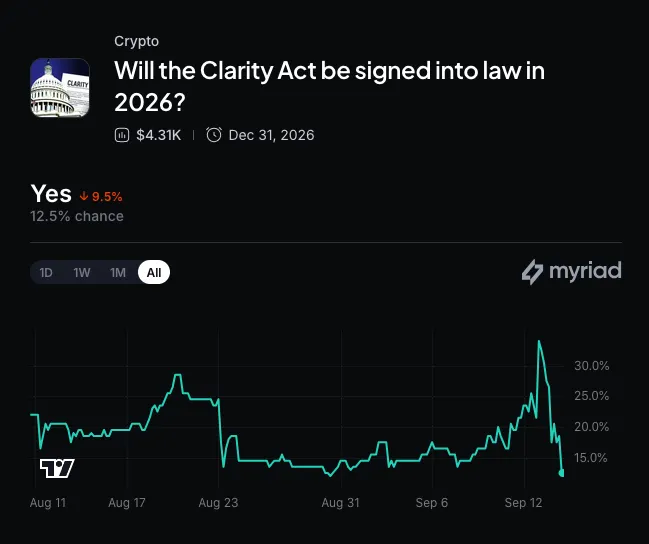
The outcome of today’s Clarity Act hearing could also “introduce additional volatility” across the sector, he noted.

On prediction market Myriad, owned by Decrypt's parent company Dastan, users place just a 24% chance on the Strait of Hormuz blockade being lifted before June, though the likelihood of crude oil prices surging to $120 has dropped from 76% Wednesday to 65% today.

The Bitcoin ETF sell-off had been building for days, with the funds shedding $268.5 million on May 7 and a further $233.2 million on May 12.

Peter Chung, head of research at Singapore-based algorithmic trading firm Presto Labs, cautioned against reading too deeply into the single-day figure.

"Institutions are a diverse bunch. The markets can rally on the back of bullish sentiment of a certain cohort of investors, but the resulting higher price may serve as a strong incentive for another cohort of investors to lock in profits," he told Decrypt, characterizing the activity as "healthy consolidation."

Myriad users are pricing a greater than 84% chance of Bitcoin's next move being a push to $84,000 rather than a collapse to $55,000—though near-term sentiment leans cautious, with users only assigning 41% chance of BTC closing above $80,000 by Friday 4 pm UTC.

Bitcoin is trading at $79,540, down 1.6% in the last 24 hours after briefly touching the $82,000 range last weekend, according to CoinGecko data.

Tip
$0
Like
0
Save
0
Views 529
HKWDB reminds readers to view blockchain rationally, stay aware of risks, and beware of virtual token issuance and speculation. All content on this site represents market information or related viewpoints only and does not constitute any form of investment advice. If you find sensitive content, please click“Report”,and we will handle it promptly。
Submit
Comment 0
Hot
Latest
No comments yet. Be the first!
Related
CFTC Chairman Says Binance Hacker Attack Indicates That Offshore Exchanges Need US Regulation
Michael Selliger, chairman of the U.S. Commodity Futures Trading Commission (CFTC), stated that the $6.4 billion hack incident at Binance “precisely demonstrates” the necessity of the crypto market regulations proposed by the agency this month. He described the attack as being more likely caused by a vulnerability introduced through a laptop rather than a flaw in the blockchain itself; however, Binance later indicated that the investigation had uncovered “more entry points” for the attack.
Decrypt
·2026-10-31 23:10:23
11
Intel experiences its largest single-day decline in over forty years; the NASDAQ falls nearly 3%, gold drops to a one-year low, and crude oil continues to rise for four months in a row.
Amazon and Intel's financial reports disappointed the market. Investors are increasingly skeptical about the returns on the huge AI expenditures of these tech giants. All three major U.S. stock indices closed lower, with tech stocks leading the decline, while energy and essential consumer goods sectors performed strongly against the trend. Driven by the Middle East situation, crude oil prices rose to a six-month high; U.S. Treasury yields fell, gold dropped to a one-year low, and Bitcoin lost its support below $77,000.
Wallstreetcn
·2026-10-31 22:30:06
31
I went on vacation with two iPhone, and Duo convinced me to do so.
The author tried out Apple's new iPhone Duo during a five-day vacation. Initially, due to application issues, Touch ID, and the camera, among other factors, they considered returning to their original iPhone. However, by the end of the trip, they changed their mind, finding that although this foldable phone has its shortcomings, it is indeed fascinating.
TechCrunch
·2026-10-31 22:21:57
34
After Binance was attacked by hackers, how should investors protect the security of their crypto assets?
On October 29, Binance was attacked by hackers, with an estimated loss of $6.3 billion, which has drawn external attention to the recovery of stolen funds, the exchange's compensation commitments, and the lack of a similar deposit insurance protection mechanism for crypto assets like FDIC. Experts say that whether an exchange compensates usually depends on its own willingness and financial capability, and while self-hosting by individuals can reduce some platform risks, it also brings new security hazards.
CNBC
·2026-10-31 22:11:08
37
Intel's market value evaporated by nearly 29% in a single day: High demand for AI, so why has the chip manufacturer seen a decline?
Intel's market value evaporated by nearly 29% on October 30, despite its artificial intelligence business experiencing the fastest growth in years. The company's revenue in the third quarter increased by 21% to $16.5 billion, with revenue from its data center and AI divisions growing by 78% to $7.3 billion. However, limited production capacity, an accident at a factory in Israel, and weak performance in the PC business led to fourth-quarter guidance that fell short of Wall Street's expectations.
Coinpaper
·2026-10-31 22:03:41
39
View More