






Ethereum: Lido Invites Joseph Lubin to Discuss Institutional Ethereum Staking
The Cryptonomist
09-15 12:19
Ai Focus
Lido will hold a community teleconference with Joseph Lubin to discuss institutional Ethereum staking, reflecting the growing interest of institutions in holding and staking ETH.
Helpful
No.Help

Lido announced that MetaMask, the Chairman and CEO, as well as Consensys, the founder Joseph Lubin, will participate in the Poolside community teleconference to be held on September 14th. The main topic of discussion will be institutional Ethereum staking. Although such events themselves do not equate to the implementation of business, considering the topics selected and the guests invited, how institutions hold and stake ETH is becoming a topic of increasing concern within the Ethereum ecosystem.

The meeting focused on the ways institutions can participate.

Lido revealed the time and guest information for this event through X. Poolside was originally intended to be a community exchange format, but the topic of this discussion clearly leans more towards institutional needs, rather than being aimed at ordinary users alone.

Joseph Lubin also serves as the Chairman of MetaMask and CEO, and founded Consensys. He is involved in wallet infrastructure and has long been at the core of the Ethereum ecosystem, making his statements an important window for observing how other organizations integrate with Ethereum.

Institutions are shifting their focus from trading to staking.

The article mentions that an increasing number of traditional financial participants no longer regard ETH merely as a tradable asset; instead, they are beginning to focus on how to utilize it after holding it, with pledging being one of the key aspects. For institutions with substantial capital, pledging means participating in network verification while holding ETH and thereby obtaining corresponding benefits.

Such demands will also drive discussions on the design of hosting, compliant access, and staking products. For the Ethereum ecosystem, if institutions allocate their funds to staking rather than short-term trading, it usually means a longer holding period. The market's perception of ETH may also shift from being merely a price-based competition to considering it as an on-chain asset with profit-generating potential.

Lido hopes to expand the coverage of its institutions.

As a relatively large-scale liquidity staking protocol in the Ethereum ecosystem, Lido itself has the motivation to attract more institutions to participate. This invitation for Lubin to engage in open dialogue also reflects the protocol's desire to establish more direct communication with participants who may bring in larger amounts of capital.

The article also mentions that discussions surrounding institutional Ethereum staking may in the future affect investment products, hosting solutions, and market narratives related to ETH. However, this teleconference is currently focused on communication, and no specific collaborations, product releases, or funding commitments have been disclosed yet.

From a news perspective, the greater significance of this event is that institutional staking has gradually shifted from a topic of industry discussion to a focus for leading protocols and core Ethereum builders.

Tip
$0
Like
1
Save
1
Views 74
HKWDB reminds readers to view blockchain rationally, stay aware of risks, and beware of virtual token issuance and speculation. All content on this site represents market information or related viewpoints only and does not constitute any form of investment advice. If you find sensitive content, please click“Report”,and we will handle it promptly。
Submit
Comment 0
Hot
Latest
No comments yet. Be the first!
Related
Solana Mainnet enables 4096-byte transactions: More space, but also brings upgrade pressure on indexers
Solana will enable v1 transaction-related functions on the mainnet Epoch on September 15th at 01:20 UTC. The maximum size of a single transaction will be increased from 1232 bytes to 4096 bytes, which is approximately 3.3 times the original size. The official upgrade page indicates that the activation is expected to occur at this time, and the mainnet status will be marked as activated. The new format provides more space for zero-knowledge proofs, large multi-signatures, batch processing, and some on-chain signature schemes, reducing the need for developers to split a single operation into multiple transactions. The existing legacy and v0 transactions will continue to function, so this is not a hard fork that requires all wallets and applications to switch immediately.
币界网
·2026-09-16 10:17:03
200
Final Launches Shannon Development Network: An "Adaptive Blockchain" Begins with Restricted Testing
The new public chain Final announced on September 15th that its first major version, Shannon, is already running on the development network. The project positions itself as an “adaptive blockchain network” and showcases a structure composed of a main chain and a transaction chain, with plans to provide core facilities such as derivatives, spot trading, and stablecoins at the protocol layer. What needs to be clarified at this point is that what has been launched is Devnet, not the mature mainnet intended for everyone. The official website states that Shannon will be open to the public “in the near future,” and the current page still provides an application access link; functions such as wallets, bridges, and documentation are also marked as upcoming.
币界网
·2026-09-16 10:15:56
181
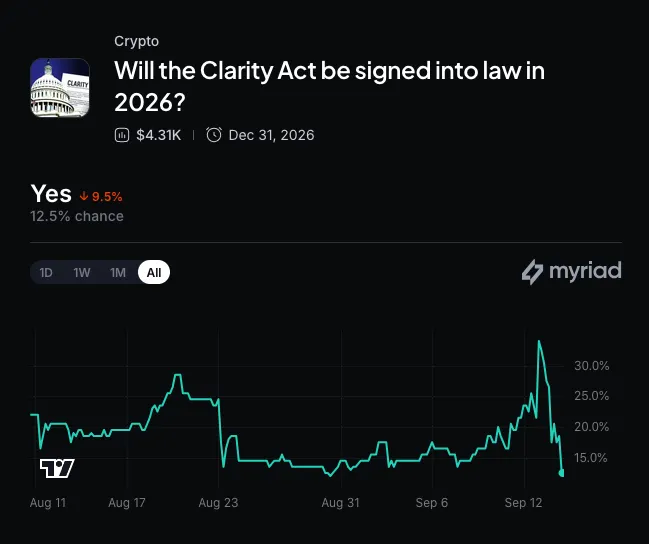
web3: The U.S. Senate fails to advance the CLARITY bill, leading to a decline in the crypto market
After the U.S. Senate failed to advance the CLARITY bill, the crypto market declined, with Bitcoin briefly falling below $75,000.
CoinPedia
·2026-09-16 03:51:21
189
web3: Obstacles Arise in the Procedural Voting of the U.S. Senate, Clarity Bill Fails to Advance
The U.S. Senate failed to advance the Clarity legislation, causing setbacks in the regulation of the crypto market structure. The industry's focus has shifted to the subsequent rules for SEC and CFTC.
CoinDesk
·2026-09-16 03:04:11
57
web3: Loomis says the "Clarity Act" has entered a critical voting phase
The U.S. Senate will vote on the advancement process of the "Clarity Act." Loomis stated that if it does not pass, the act may have difficulty moving forward again within 2026.
Coinpaper
·2026-09-16 01:58:22
140
View More